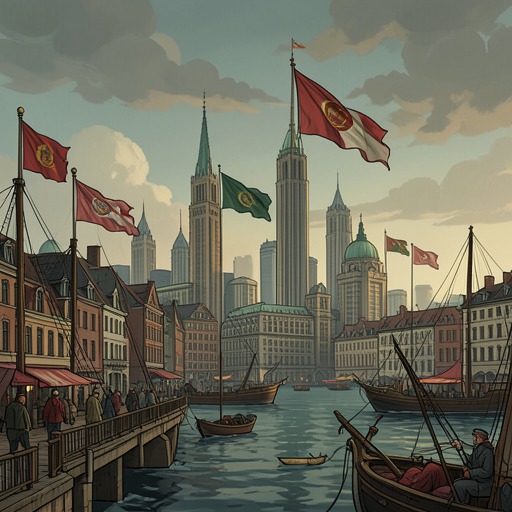
Kingdom of the Two Sicilies
The Florios of SicilyThe Kingdom of the Two Sicilies is the political framework against which the book traces Sicily’s contested autonomy and the Florios’ commercial fortunes. Its return to centralized rule places Neapolitan officials over Sicilian administration, while later revolutions and unification make ships, customs, credit, and trade direct instruments of political power. The kingdom matters not only as a regime but as a force that can alter who governs Sicily and who controls the means of its prosperity.
Centralization and the loss of Sicilian autonomy
The account links Bourbon restoration to the failure of Sicilians to act together. Palermo, Messina, Trapani, and Catania remain divided, despite their shared hostility to rule from beyond the Strait of Messina. After the Bourbons return to Naples, state offices and customs come under Neapolitan administration from December 1816, and Neapolitans also take command of the military. Palermo loses its political power and independence; heavier taxes, restrictions, and new limits on trade bring an already weakened economy to a halt.
The 1820 revolt grows from aristocratic opposition and secret-society networks, amid resentment that Bourbon rule has united the kingdoms and revoked the 1812 constitution. The uprising restores the Sicilian Parliament and constitution, while a related mainland insurrection compels Ferdinand I to accept a constitution. But the aim of restoring the Kingdom of Sicily collides with Bourbon interests and divisions among Sicilian cities. The revolt is suppressed, the monarchy is restored in November, and Sicily returns to Neapolitan government. In March 1821, forces of the Holy Alliance defeat the insurgents; Austrian troops enter Naples and restore the king to his throne, remaining there until 1827.
Economic policy and commercial pressure
The novel also depicts the kingdom as a promoter of economic and technological development. After Ferdinand II becomes king in 1830, his government pursues economic and social revival through political and tax review and investment in infrastructure. Engineering, railway construction, and metal-hulled military ships receive support; the first pension system in Italy is established, and work begins on a network of electric street lighting. The government’s effort to improve sulfur extraction, however, brings it into open conflict with British and French interests seeking to buy sulfur below market prices.
State power is felt especially sharply when political disorder disrupts ordinary commerce. During the revolution, customs becomes disorganized, outgoing ships are blocked, and merchants and seamen crowd the Customs House while soldiers attempt to keep them back. The interruption threatens the Florios’ shipment and turns the administration of ports into an immediate business crisis. Later, Vincenzo explains that the revolutionary committee has requisitioned ships and effectively compelled a loan, while trade has fallen by half. The Palermo, operating at full capacity for the Sicilian Steamship Company, is taken by the revolutionary regime to transport troops.
Revolution, finance, and the limits of sovereignty
Vincenzo’s involvement in the 1848 revolutionary government exposes the tension between commercial responsibility and political commitment. He tells Giulia that he has bought a large consignment of rifles in England on behalf of the revolutionary committee. The Kingdom of Sicily has been proclaimed, but no prospective monarch is willing to accept its crown; British opposition to separation from the Bourbons further complicates the effort to establish a government. The revolutionary administration’s attempt to revive the 1812 constitution therefore proceeds without a settled sovereign, even as the Florios’ ships and money are drawn into the conflict.
At a later moment of political crisis, Vincenzo uses his position as a trade governor to protect liquid assets. He orders all cash and bank drafts transferred into the Royal Bank’s safe, expecting the money to be returned to circulation or converted into a new currency once the crisis ends. He cannot similarly secure the substantial gold ingots in the treasury: Garibaldi’s men are expected to requisition them within hours. The episode shows the limits of private commercial prudence when competing authorities claim the state’s resources.
Annexation and the disputed meaning of unity
After Sicily’s incorporation into the new political order, Vincenzo denounces the transfer of the Bourbon Crown treasury to Piedmont to pay for the annexation campaign. He calls the annexation a deception staged by Naples and Turin and fears that the island is being reduced to a colony. Giulia counters that a united nation, extending from the Alps to Marsala, might honor those who sacrificed their lives for national unity. Their disagreement gives the kingdom’s political history a personal and economic dimension: Vincenzo measures sovereignty by whether outside powers can interfere with his world and Casa Florio, while Giulia asks him to reckon with the sacrifices made for a broader national ideal.
Across these shifts, the kingdom’s authority is shown through concrete mechanisms rather than abstract titles: constitutional revocation, tax and trade restrictions, customs administration, military command, requisitioned ships, forced lending, and the transfer of treasury gold. These pressures make political change inseparable from commercial life. The Florios can build wealth and influence, but their shipping and finance remain exposed whenever sovereignty is contested or reorganized.